

































Sunday December 28, 2008 / Filed under: Roving Photographer
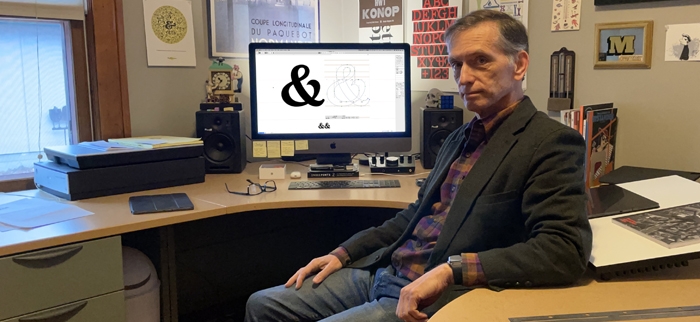
R & Nails?

At first glance, I thought it said “R & Nails” with some sort of weird ampersand, but a second look reveals that it actually says “Red Nails.”
I wouldn’t recommend hiring a graphic designer to do a manicure, either.
Monday November 24, 2008 / Filed under: Font News
Coming Soon: Diane Script
I recently partnered with Mark Solsburg of FontHaus, who has lately become fascinated with twentieth century French type foundries and type designers, to create a faithful digital revival of Diane, a typeface designed by Roger Excoffon. It was released in 1956, around the same time as his more famous Mistral and Choc. For reasons that aren’t clear to me, Diane seems to have never become as popular as his other faces, especially in the U.S. Finding full specimens of the font turned out to be quite a challenge. In many cases, only the caps and lowercase are shown.
With Mark’s help, I was able to get hold of source material from the University of Groningen in the Netherlands, D. Stempel GmbH metal type services in Frankfurt, Germany, as well as from some type specimen books that I already had in my possession.
As I researched and studied the face, many curious facts came to light. The caps in earlier specimens of Diane are completely different from specimens published later, suggesting that the face was redesigned at some point, perhaps in the mid-1960s. So we are left with two different sets of caps.
The original had very elaborate, swirly strokes, characteristic of Excoffon’s gestural designs for posters and logos. Later on, these appear to have been replaced by a set of simpler, more traditional script caps. The original caps are criticized in one source I found (“Practical Handbook on Display Typefaces”, 1959) as being “exquisite” but “not highly legible”. Perhaps this is what led to the simpler caps being introduced.
Even more curious, the caps shown in the Olive specimen “3 Scriptes” that accompanied its release in 1956 are noticeably different from the ones found in existing Diane metal fonts. The only conclusion I can make is that Diane, as it was shown in the “3 Scriptes” specimen, was not yet finalized when this was published. (Some of these earlier character designs are included in my revival.)
Changes appear to have been made in the lowercase as well. Several characters have non-connecting incoming strokes in the 1956 version. In the later version, the strokes all connect. The lowercase o also differs, with the original “3 Scriptes” specimen showing a loop inside the counter, apparently dropped in the released version.
In my digital revival of Diane, I’ve included many of these differences. Diane Script Première includes the beautiful caps from the original version, while Diane Script features the later, simpler caps. Both faces include the non-connecting lowercase characters and the earlier lowercase o as alternate characters. Diane Script Première includes three of the “unfinished” caps from the “3 Scriptes” specimen as alternates.
Of course, metal foundry faces had nowhere near the number of characters that modern digital faces do, so it was necessary to design quite a few new characters to match Excoffon’s original ones. This proved to be a fairly straightforward process, with one exception: the ampersand.
As hard as it is for me to believe, it appears that Diane never had an ampersand. None of the specimens I’ve found so far has shown one. I still hold out the possibility that one exists, and intend to add it if it turns up. In the mean time, I have come up with two that I am satisfied with. The first is a simpler design to go with the simpler caps in Diane Script. In the second, I tried to capture the energy and exuberance of Excoffon’s original caps. Studying Excoffon’s gestural design work was very helpful for this. Diane Script Première includes both ampersands, with the simpler one as an alternate.
Diane Script and Diane Script Première are not the first attempt to revive Diane digitally. However, in my research, I discovered a detail that previous attempts have gotten wrong: the alignment and spacing of the caps in relation to the lowercase. Unlike most typefaces, Diane’s caps actually sit slightly below the lowercase baseline. The most easily found specimens of Diane show the caps and lowercase separately, so this fact is hidden. Luckily, my source material included a few obscure specimens in which the correct relationship can be seen.
Several of the lowercase letters have disconnected outgoing strokes, intended to connect to the following letter. However, when it falls at the end of a word, the disconnected stroke is conspicuous and unnecessary. In the metal typeface, this was apparently an acceptable compromise. But in OpenType format, we can have it both ways. When such a character falls at the end of a word, the orphaned stroke is omitted automatically. (An OpenType-savvy application and/or operating is system required for this feature to work.)
In reviving Diane, I’ve sometimes felt more like a detective than a type designer. I’m very happy with the way it turned out and hope my efforts will bring new life to Roger Excoffon’s masterpiece.
Diane Script and Diane Script Première are available now from FontHaus.
Friday November 21, 2008 / Filed under: Old Type & Lettering
The End
A big collection of “End” titles from old movies. Most of these were hand-lettered. Wow!
(via Daring Fireball and DaughterNumberThree.)
Wednesday November 19, 2008 / Filed under: Son of Typecasting Links
Yves Peters Gets In on the Fun
Fellow type geek Yves Peters gets in on the fun of spotting typographic anachronisms at FontShop’s FontFeed blog today with a post about some odd props on the TV series Dexter.
Tuesday November 11, 2008 / Filed under: Font Sightings
Font Sightings: The Next Generation
Ever since I started Notebook, I’ve been occasionally posting “font sightings” and I even have a special category for them. It worked okay, but the samples I’ve posted here have been kind of small, and I thought it would be really neat if, somehow, all the Coquette sightings could appear on the Coquette page, for example.
For a while I’ve had this idea of using Flickr as part of a new and improved Font Sightings system. I finally stopped thinking about it and did it. It was actually pretty easy, if a bit tedious.
I already had about a bunch of photos of font sightings in Aperture, and I picked about a hundred of the best ones. After spending some time naming and tagging them, I used the Aperture Flickr upload plug-in to get them all up on Flickr.
The second step was to add some special code (from Flickr) to the font pages and Notebook to display a set of three random sighting and provide a link to the appropriate photos on Flickr (see the top of the column to the right).
So far, I’ve only uploaded what I already had in Aperture. I still need to add all the stuff people have sent me over the years (thanks to all who have), plus all the stuff I don’t have photos of yet. Some fonts aren’t yet represented mostly because I didn’t have sightings of them in Aperture. These will be coming soon. Some of them, like the newer ones and poor old Sharktooth, I’ve just never seen used yet.
From now on, new font sightings will appear on Flickr and (randomly) on the right-hand column of Notebook and the font pages. The “Font Sightings” category for Notebook is basically dead. Long live Font Sightings!
If you have seen any of my fonts out in the wild, or maybe have created designs using them, feel free to send photos or scans to mark@marksimonson.com.
Thursday November 6, 2008 / Filed under: Miscellany
Ginkgo + Fall = Stinko
We have a fair number of ginkgo trees in our neighborhood. I don’t pay much attention to them most of the year, except in the Fall. That’s when, in their curious way, they drop nearly all their leaves in one go, not even waiting until they change from green to yellow. That happens after they’ve been lying on the ground a few days. And when they fall, each tree is surrounded by a rich, green carpet of ginkgo leaves.
Unfortunately, some (not all) of them also drop hundreds of yellow, cherry-sized seeds. Or maybe they’re fruits. Or nuts. Doesn’t matter. Very soon, the sidewalks are covered with them and they get trampled on. The mess is bad enough, but the smell is revolting. I wish people who have these trees would at least sweep the seeds off the sidewalk. I guess they don’t go for walks around the neighborhood like me. They probably do it on a treadmill at a health club. Grr.
Pretty leaves, though.
Friday October 31, 2008 / Filed under: Old Type & Lettering
Brede Building
It’s hard to believe this still exists. It’s a classic art deco industrial building, complete with art deco neon sign. And it’s not falling down, or in danger of being razed. It’s as if 70 years of architecture and design have overlooked this little spot on Broadway Street NE in Minneapolis. They seem to know what a rare gem they’ve got, and I hope they never change it.
Tuesday October 14, 2008 / Filed under: Roving Photographer
Yellow Rectangle, Green Square
Photo taken on August 16, 2008, in Zumbrota, Minnesota.
Friday October 10, 2008 / Filed under: Personal Archaeology
Illustrator 1.0
I happened to be looking at Reuben Miller’s blog today and stopped when I got to the item “Introducing Illustrator 88” in which he embedded a link to a YouTube video showing a portion of the VHS tape that shipped with Illustrator 88. I have that tape and also the one that came with Illustrator 1.0. (And the disks, and the packaging. I know. It’s a disease.) I’d been toying with the idea of digitizing these videos and posting them online, but someone saved me the trouble. (It appears that John Nack of Adobe posted the 1.0 video.)
I particularly remember the tape that was included with 1.0, which featured John Warnock, the CEO and founder of Adobe himself, doing the demos. I’ll never forget the way he exclaimed “Isn’t that neat?” after showing how the pen tool works. And it was neat. The YouTube clip only shows about the first ten minutes of the tape, so it’s missing that little gem.
It’s amazing how good the program was right from the start. It had a long way to go (no color, no layers, no drawing in preview mode, no composite paths, only one font in a text block, no converting text to outlines, no pathfinder tools, etc., etc.), but the foundation was solid. It sure looks slow running on that tiny Mac Plus screen, though.
Tuesday October 7, 2008 / Filed under: Son of Typecasting
Mad Men, Mad Props
I started watching the critically-acclaimed series Mad Men on DVD over the summer, and I am enjoying it a lot. I was a little kid in the early 1960s. Watching it is like stepping back in time. People really did used to smoke and drink like that. Of course, the show is set in the early 1960s, so I had to write a “Typecasting” piece about it.

Considering that the show is about an advertising agency, there isn’t as much type on Mad Men as I would expect. When there is, it’s usually used they way it would have been in the early Sixties, except it seems the type choices are limited to whatever happens to be loaded onto the computer.

The show starts out with stylish opening titles featuring glimpses of real ads from the period—and a clinker: What’s Lucida Handwriting (1992) doing here? I usually consider the titles to be outside the world of the story, but considering all the period cues in these titles, this typeface, which was designed specifically for computer screens, is out of place.


Then there is the Gill Sans (c. 1930) problem. Gill is used quite a lot in the series, mainly for Sterling Cooper Advertising’s logo and signage. Technically, this is not anachronistic. And the way the type is used—metal dimensional letters, generously spaced—looks right. The problem is that Gill was a British typeface not widely available or popular in the U.S. until the 1970s. It’s a decade ahead of its time in American type fashions.


This is not to say that they never get it right. Here we see signage similar to what they have at the agency, but in this case using the more plausible Futura.

This grocery store interior is also quite good. Some casual brush style lettering and Futura again, not feeling out of place at all.

This beer label caught my eye: Was there really a Fielding beer brand that had labels exactly like Hamm’s beer, but with green instead of blue? (By the way, the beer cans in the show are opened with can openers. No pop-tops here. Nice detail.)

Then there are the ad layouts, supposedly produced by the art department at Sterling Cooper. You can tell the layouts are done with markers and pencils, as they would be, although they seem too sketchy. Perhaps this is to help them “read” as marker layouts on tv. The ad designs feel flat-footed and mediocre, but we also know that Sterling Cooper is not in the vanguard of advertising—they scoff at this clever and now-famous Doyle Dane Bernbach Volkwagen ad—so maybe that’s intentional. On the other hand, they are way ahead of their time when it comes to type, using faces that didn’t even exist yet.

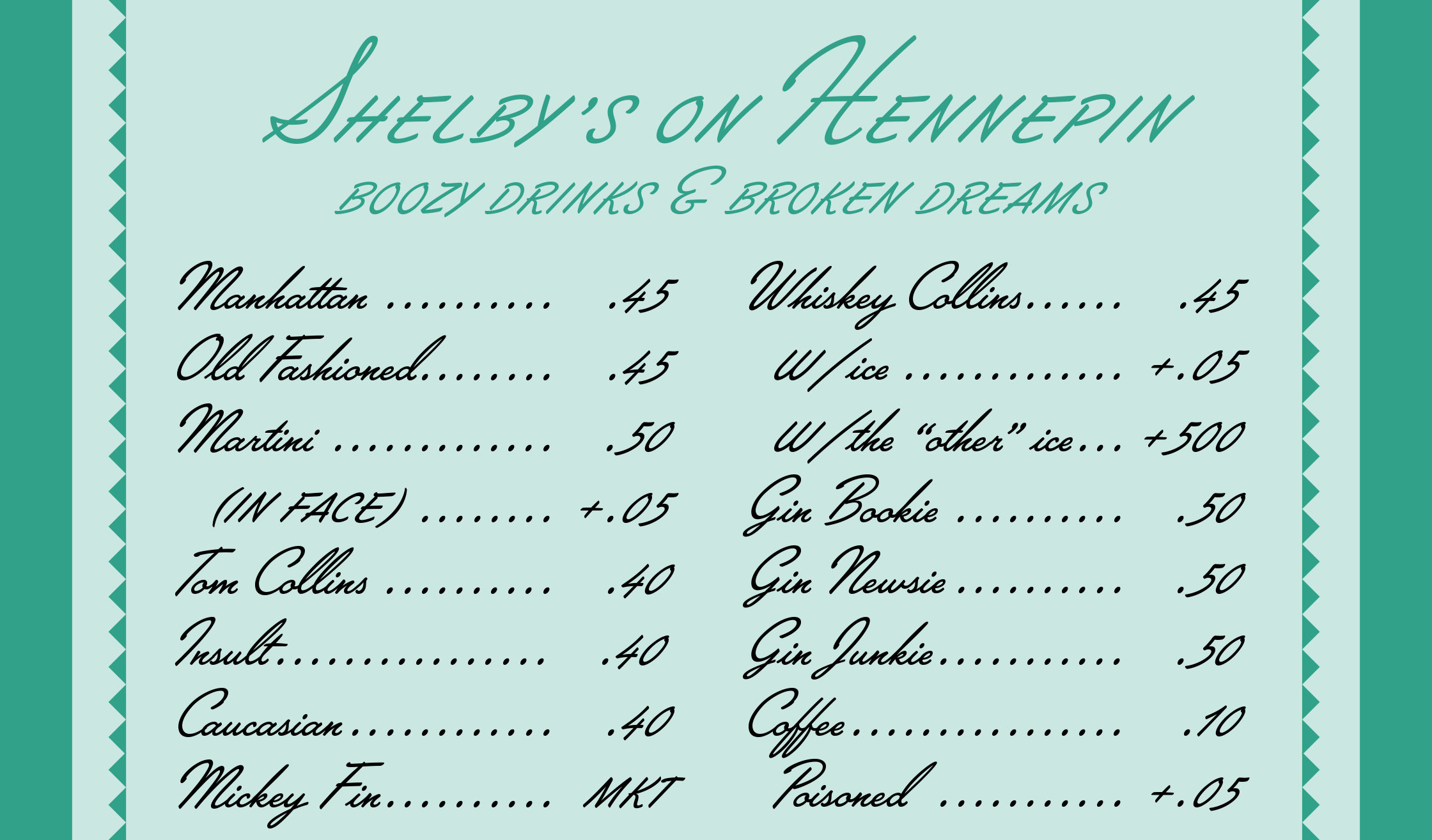
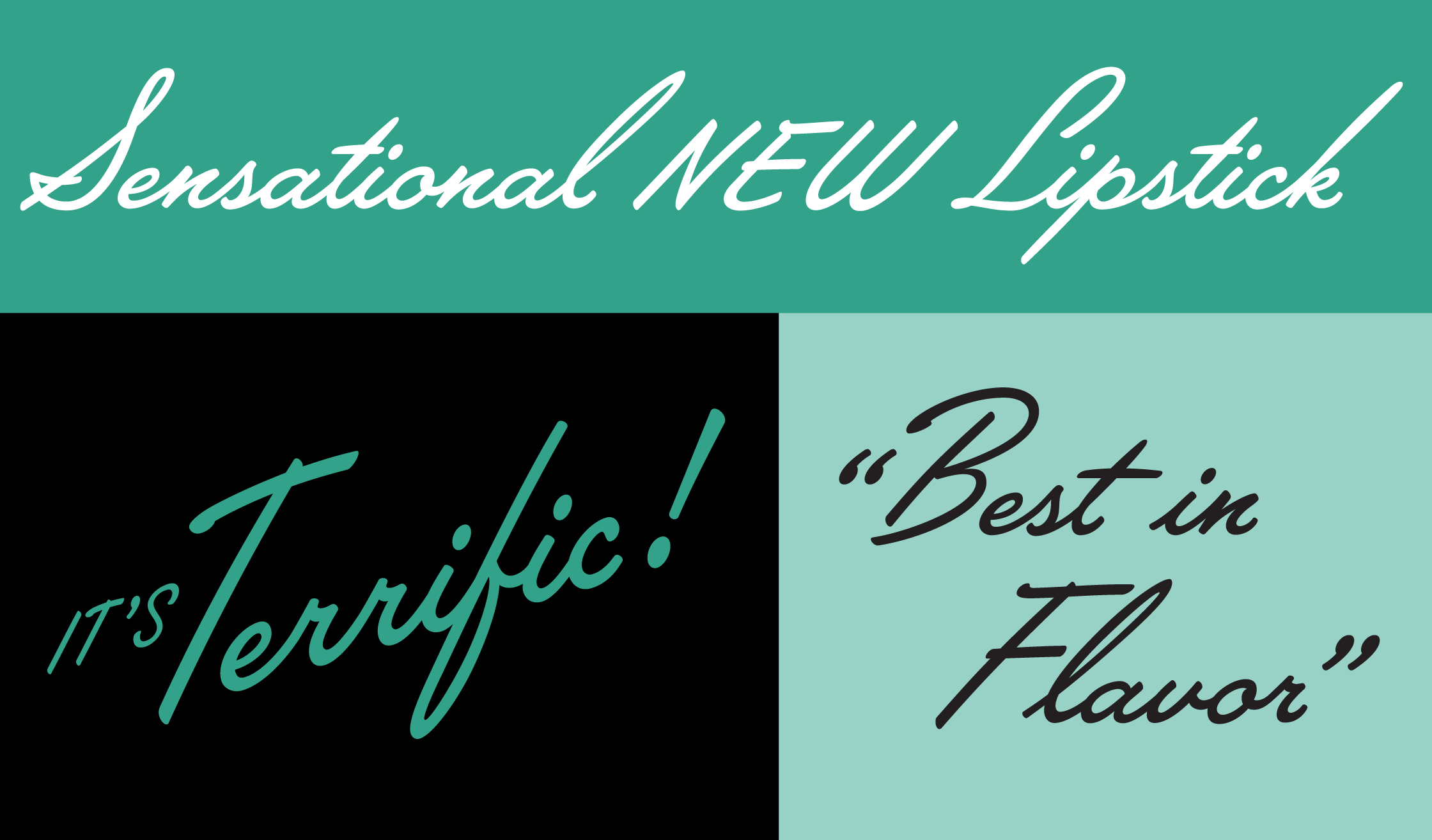
These lipstick ads feature Fenice (1980) with Balmoral (1978) for the script caps. Amazone (1958) for the script lowercase is fine here, but the outline looks too much like a modern computer graphics effect (which is what it is).

Here is some hand-drawn ITC Kabel (1975) and, I’m pretty sure, Bookman Old Style (1989), one of Monotype’s ITC stand-ins.

Whoops—Zapfino (1998). I guess they use Macs.

Gill Kayo did exist at the time, but wasn’t in style yet and feels out of place on this church flyer. Gotham (2002) is just wrong. The blown up vintage clip art seems odd here, too. The whole layout has a Kinko’s feel to it.

There is also this curious American Airlines ad featuring Helvetica several years before Massimo Vignelli famously redid their corporate identity using… Helvetica.

The church bulletins are a bit problematic, partly because they are typeset (the ones I remember were mimeographed). Palatino (1950) existed, but didn’t really catch on in popularity in the U.S. until around 1970. And Snell Roundhand (1966) is definitely premature. This feels more like desktop publishing than early Sixties ephemera.

Speaking of which, the sets of Mad Men are filled with actual artifacts and ephemera from the early Sixties—magazines, books, packaged goods, furniture, art, record jackets, typewriters. This is great (and it must be a lot of fun to scrounge for props), except that sometimes you can tell this stuff is really old, especially anything made of paper. I can almost smell the mildew when Betty Draper is reading her yellowing copy of Family Circle.

The ad writers listening to a then-new Bob Newhart comedy album was a nice touch, except that it looks like they got their copy at a Goodwill store.

Alert fans have noted that Seventies-era IBM Selectric II typewriters are used on the show, but even these have visible signs of age, such as the yellowed plastic shield you can see in this shot. I wish they would figure out a way to make these props look less aged. I sometimes feel like these characters are living in a retro museum instead of 1960s New York.

I don’t mean to be so hard on Mad Men. I dearly love this show. If it were a two hour movie instead of a season and a half (so far) of one-hour tv shows, this would be a much shorter article. And the fact that the shows are broadcast in HD makes it all too easy to scrutinize the props. But, I have to admit, scrutinizing the props is part of the fun of watching Mad Men.
(Special thanks to reader Michelle U. for reminding me I needed to watch this series and look at the type.)
Update: I forgot to mention the (I hope) thoughtless choice of Arial for the closing credits. Happily, this territory was nicely covered recently by Andrew Hearst.
Friday October 3, 2008 / Filed under: Font News
Introducing Filmotype Ginger

Ginger is the most recent Filmotype font I’ve digitized. (See also Zanzibar and Glenlake.) It’s the first in a range of Filmotype “G” series fonts—condensed sans serifs whose names all start with “G”—that have many Futura-like features that are unusual for the style. I was interested in this range of typefaces even before I knew about Filmotype. Few of them have ever been digitized before. I plan to do all of them eventually (sooner than later, I hope).

To bring Ginger into the 21st century meant designing dozens of new characters to expand its limited character set. Caps, lowercase, numbers and a few symbols and punctuation marks might have been okay back in the 1950s, but today’s fonts are global citizens and have to play as well in Prague as they do in Peoria. In designing the new characters, I tried to imagine how Ginger’s designer would have designed them. (We know who designed some of the Filmotype fonts, but not Ginger. Over the years many of the records of who did what were lost.)

Like all the new Filmotype revivals (available from Font Bros), Ginger has been remastered to high standards and is a modern font in every way. It is available in OpenType format, which means you can use the same font on either Mac or PC, and includes many OpenType goodies, such as an alternate lowercase “a”, arbitrary fractions, case-sensitive forms, and extensive language support.

Filmotype Ginger is available now from Font Bros.
Thursday October 2, 2008 / Filed under: Old Type & Lettering
Parkside Candies
While I was off doing type things at TypeCon in Buffalo this last July, my partner was off seeing the city. She got a picture of this breathtakingly beautiful old sign. Wow.
Monday September 29, 2008 / Filed under: Personal Archaeology
Interview on LetterCult
Almost forgot to mention: I did an interview with LetterCult, the new website devoted to the art and culture of making letters. It just went up today. Link.
The site’s been up less than a week, but there’s already a ton of great stuff on it about lettering and type design.
Saturday September 27, 2008 / Filed under: Type History
The Lost Art of Type Spec'ing
Here is an example of what designers used to have to do in the days before desktop publishing:
All this for a few blocks of text. In this case, for a client’s stationery. It’s from about 1986 or so. I was already starting to use PageMaker for some jobs, but high resolution output was not available quite yet in Minneapolis, and 300 dpi LaserWriter output would not do for a job like this.
Note the note at the bottom: “Tuesday A.M. if possible.” It was probably sent out on a Monday (delivered via courier), and would have been considered a “rush” job. The markings in blue and light red were made by the typesetter to themselves. The others are mine. I don’t remember exactly, but it probably cost $75-$100 to have this copy typeset, including delivery charges.
There was never any question that the spacing and quality would be anything but perfect. None of this had to be stated in the “specs” unless something unusual was called for, like the note near the bottom that says “K 1/2 U” meaning “kern one half unit.” The finished “repro” would still need to be cut up and pasted into position on illustration board before it could be printed.
We are so spoiled nowadays. We can set the type ourselves, right at our desks (or laps), and instantly see what it will look like. No more spec’ing, or waiting, or paying big typesetting bills. On the other hand, you do have to know a lot more about setting type than you did back then to get the same level of quality.
(A possibly interesting footnote: The copy was printed out on a dot-matrix printer, an Apple Imagewriter II, using bitmapped fonts I made myself on my Mac, including one that mimics the look of a typewriter.)
Wednesday September 17, 2008 / Filed under: Links Miscellany
Typographunnies
Click at your risk: Typographunnies.
Saturday September 13, 2008 / Filed under: Links
Highly Misleading

My friend David Steinlicht recently posted a time-lapse movie showing the day-to-day progress of his award-winning entry to the seed art competition at the 2008 Minnesota State Fair. It depicts a scene from the video game Grand Theft Auto (of which he is an avid player) with a can of Festal sweet corn. In seeds. Not your typical seed art subject, but David is not your typical seed artist.
The speed at which the work progresses is highly misleading. To put things into perspective, David includes video of the process in real time after the time-lapse part.
Friday September 12, 2008 / Filed under: Links Old Type & Lettering
Little Nemo Title Panel Lettering
I’m a long time fan of Winsor McCay, including his hand-lettered titles. Blogger “Morpheus” has posted a big collection of title panels from McCay’s Little Nemo comics on his “Meeting McCay” blog. Amazing stuff. (Via Boing Boing
Wednesday August 20, 2008 / Filed under: Son of Typecasting
Back to the Fonts of the Future
The Back to the Future series is a long-time favorite of mine. And they did a good job with their period-specific props—lots of hand-painted signs in the parts set in the 1950s and 1880s, just as there would be. Nary a font in sight where fonts should not be. Or so I thought.
Yves Peters (of Unzipped and elsewhere) was recently watching the third installment in the series on tv when he spotted this and alerted me:

Great Scott!, indeed. It goes by pretty fast and I had to adjust the brightness to see it clearly, but there it is. How did Helvetica (1957, top) and Eurostile (1962, middle) end up on a tombstone in the year 1885? I guess we’ll have to wait for a fourth Back to the Future movie to find out.
Wednesday July 23, 2008 / Filed under: Type Industry
TypeCon 2008 Goodie Bag Postcards

I’ve finally had a chance to settle down after this year’s TypeCon, which was one of the best I’ve attended. As promised, here is the set of 3D postcards I contributed to the goodie bag for those who were not able to attend:
Tip: Click on the images to see a larger version. And, of course, you will need a pair of anaglyphic glasses with red and blue filters to experience the illusion of depth.
In fact, these RGB images work even better than the printed postcards for the 3D effect, probably because the colors are more pure. On the other hand, they are not as easy to mail.
Saturday July 12, 2008 / Filed under: Type Industry
TypeCon 2008 in Buffalo
I’m en route this weekend to TypeCon 2008 which is being held in Buffalo, New York, home of Buffalo Wings, Ani DiFranco and P22 (the type foundry). The workshops start on Tuesday and the main program kicks off on Thursday evening.
I’m a 24 Point sponsor this year which, among other things, lets me add something to the goodie bag that each of the attendees receives. Since this year marks my fifth anniversary of attending TypeCon, I decided to make it something special to mark the occasion.
In the middle of 2002, I was just barely in the font business, selling a few fonts a month on MyFonts.com, which had just started up about a year before. I did a graphic on my website to promote one of my fonts, Refrigerator. It was an “anaglyphic” image, meaning that if you viewed it with a set of those goofy glasses with the red and blue filters like they used for 3D movies in the ’Fifties, the image would appear to have depth. Here is the image:
I don’t know whether it got anyone to buy a font, but not long after I posted it, I got an email from a guy named Stuart Sandler wanting to know how I did it. I sent him a full explanation of the process (which I posted here later in How to Make 3D Anaglyphs). He thanked me and, by the way, would I be interested in getting involved with TypeCon 2003, which was to be held in Minneapolis?
Stuart was (and is) the proprietor of the Font Diner, at the time operating out of Fridley, Minnesota, and was also on the board of SOTA, the organization responsible for TypeCon. My type design activities at the time were limited. I worked alone and didn’t really know anyone in the business. Getting involved with TypeCon 2003 opened a whole new world to me. I met type designers and developers from all over the world and for the first time had an inkling that I might actually be able to this for a living.
And now, five years after my first TypeCon, I’m a full-time type designer. And I can trace it all back to that 3D picture of a refrigerator. So, to commemorate the occasion, I have produced a set of six 3D postcards (glasses included) for each of the attendees of TypeCon this year.
Before the end of TypeCon, I will post the images on my site so everyone else can enjoy them. (You’ll have to provide your own glasses, though.)
Thursday July 10, 2008 / Filed under: Old Type & Lettering
T.E. Stone Ltd.
UK reader Aled Williams sent me this photo of a beautiful hand-painted sign on a hardware store in Bristol. Just lovely.

Update (7/12/08): More photos from the same neighborhood by Jon Tan on Flickr.